Disclaimer
As I have explained on several occasions, the overall communication for the blog “Vu Du Droit” (created twelve years ago) is now centered around the Substack account titled “Régis s’Substack.” This platform offers particularly effective features, notably the ability to subscribe, support various formats (written content and videos), and a whole host of other digital features that allow for seamless integration with other networks where we are active: Facebook, Twitter, YouTube, etc.
As for video interviews, we have a YouTube channel that was launched four years ago and had been dormant for the past few months. More than 232 videos have been posted there since its creation, particularly those offering counter-information to counter the delusional propaganda spewed by the mainstream media since Russia’s intervention in Ukraine. We have therefore decided to resume publishing both on “Régis’s Substack” and on YouTube. As for Substack—and this is today’s topic—we are also planning to publish written versions of the interviews. We believe this dual approach offers readers a more nuanced perspective, allowing for a different engagement with the information being shared.
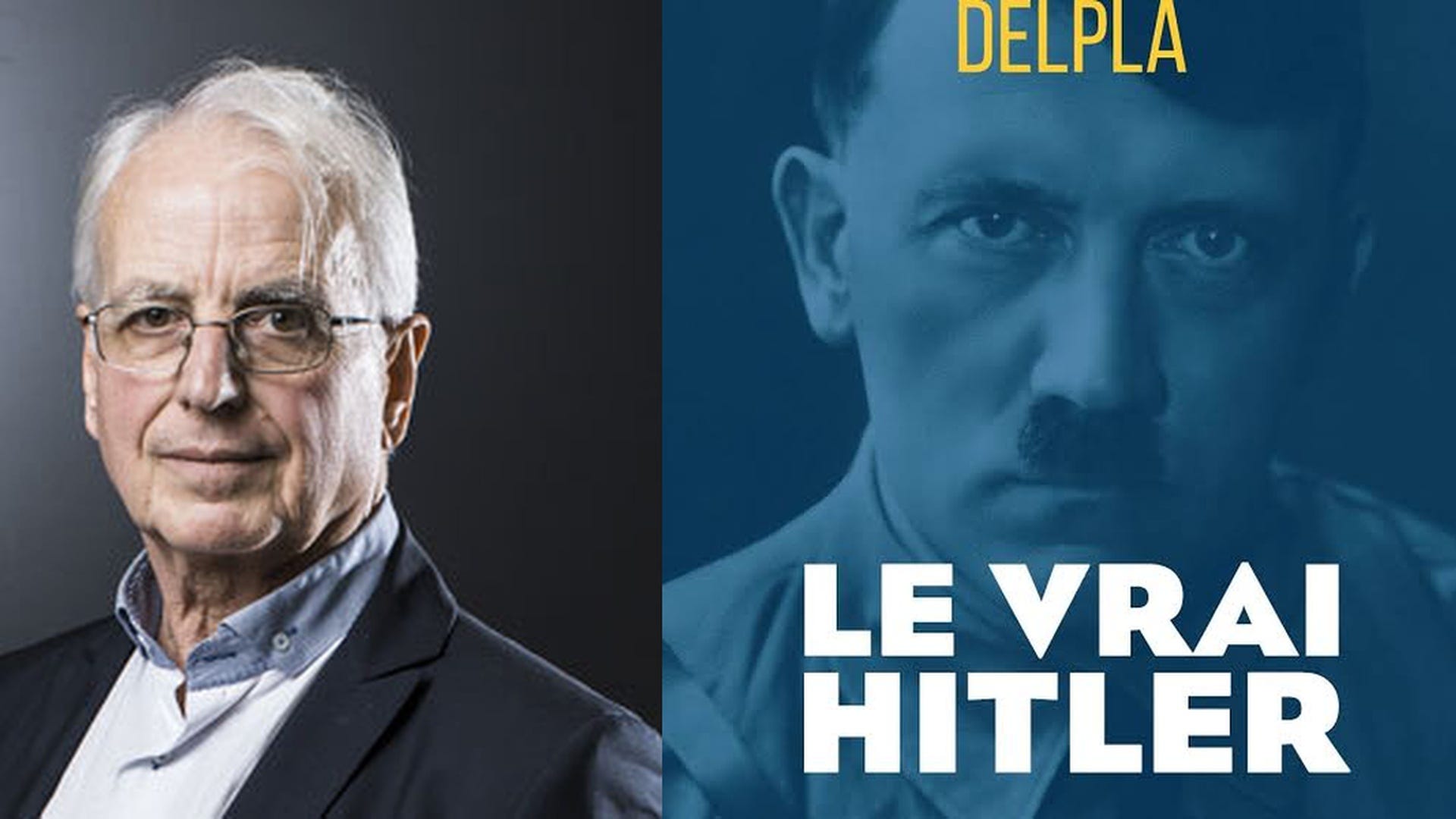
We’re going to conduct an initial trial with the written version of the interview François Delpla granted us regarding the publication of his book *Le vrai Hitler*. In it, we discuss with him an important issue during this particular political period our country is going through. Questions regarding Adolf Hitler’s personality, the circumstances of his rise to power, and the conditions under which he exercised that power are essential. This comes as parallels between the interwar period and the situation currently unfolding in France are multiplying.
On this occasion, we will attempt for the first time to use one of the polling systems offered by Substack. For this first attempt, we will use the simplest option.
The Real Hitler: A Madman at the Helm
By Régis de Castelnau
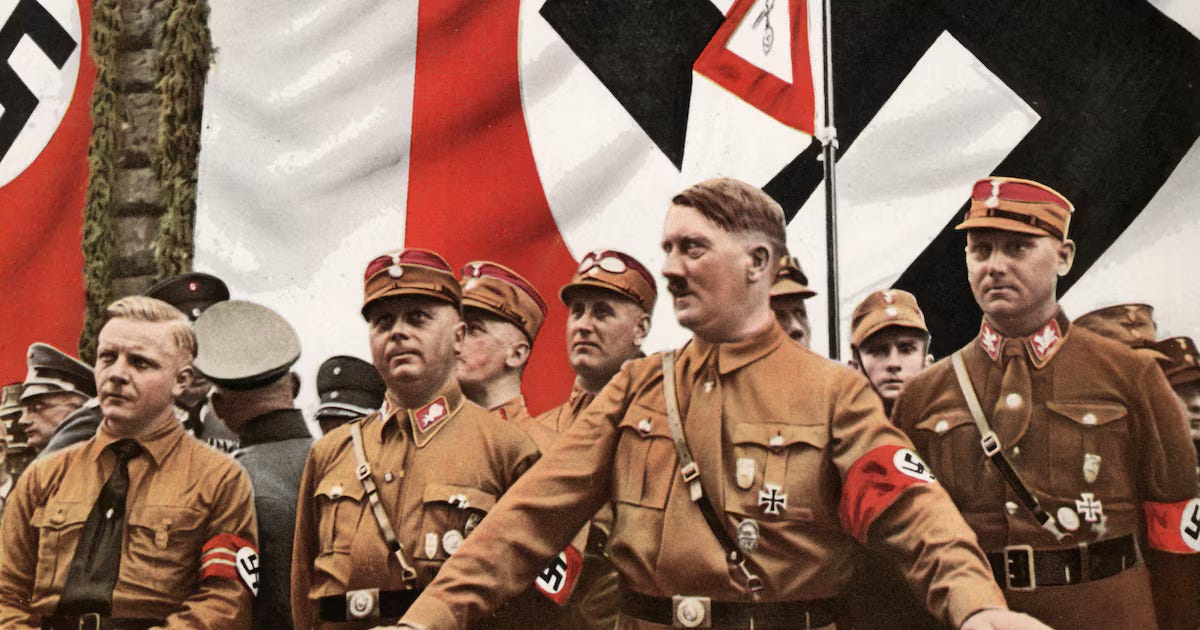
EXCLUSIVE INTERVIEW – Hitler was neither the uneducated slacker of legend nor a mere puppet of the German upper class, argues historian François Delpla in *The Real Hitler*. In conversation with Régis de Castelnau and Éric Branca, he describes a madman convinced he was on a mission from Providence, who was also a masterful politician. The three men then reject the parallel between the National Rally’s rise to power and that of the Nazis in 1933.
François Delpla is a historian. He has published more than twenty books, including *Sur ordre d’Hitler* (Cerf, 2025), and has translated and annotated *Adolf Hitler’s Private and Political Remarks* (Nouveau Monde, 2016). *Le Vrai Hitler* was published in September 2026 by Éditions du Cerf.
Éric Branca is a historian. He is notably the author of *L’Ami américain*. *Washington Against de Gaulle, 1940–1969* (Perrin, 2017), *Hitler’s Forgotten Interviews, 1923–1940* (Perrin, 2019), and *The Eagle and the Leopard: The Dangerous Liaisons Between England and the Third Reich* (Perrin, 2023).
Uneducated, lazy, fanatical, a mere tool of the upper middle class determined to shift to a terrorist form of domination: this is the “conventional wisdom” about Hitler that François Delpla sets out to dismantle. His book was originally to be titled “20 Misconceptions About Nazism”; he retained that structure—twenty chapters that can be read in any order. In it, the historian describes a man convinced that Providence had entrusted him with a genocidal mission as early as 1919, who halted his tanks at Dunkirk to secure peace with London and kept a close watch on those around him right up until his final days.
Régis de Castelnau, who is relaunching his channel Vu du droit after having devoted much of its content to military issues since the Russian intervention in Ukraine, had already hosted him for *Sur ordre d’Hitler*. Also seated at the virtual table is historian Éric Branca, whom he often meets on the Tocsin channel, where both contribute. Reading *L’Ami américain*, which focuses on the relationship between Charles de Gaulle and the Americans, one gets the impression, says Régis de Castelnau, that he served as a consultant for the film *La Bataille de Gaulle*, with its account of the AMGOT; he also greatly enjoyed *L’Aigle et le Léopard*, which explores the connections—perhaps both cultural and ideological—between Germany and Great Britain. The conversation turns to current events: the parallel, widely drawn today, between a Marine Le Pen election victory and Hitler’s rise to power.
A Leader Sent by Providence
Régis DE CASTELNAU. – Your title was somewhat imposed on you by the publisher. Yet I find it apt, because this book—which I believe is indispensable at this time—goes against a conventional wisdom that I myself have to some extent shared. That of an uneducated, lazy, fanatical Hitler: the image from the famous film *The Downfall*—a very important work that has been widely parodied on social media to create some rather funny content—in which he seems to mock what will happen to the German people after defeat, because they allegedly failed to live up to the mission that Providence had entrusted to him. There’s also the image of Hitler as a mere tool of the German upper middle class. This common narrative allows some people today to claim that the election of Marine Le Pen would be the exact equivalent of Adolf Hitler’s rise to power on January 30, 1933. What did you set out to achieve with this book?
François DELPLA. – The book was originally titled “20 Misconceptions About Nazism.” It was the publisher who, upon seeing the final result, suggested this change, and I accepted it without hesitation: the title is much more ambitious. The structure remained the same: twenty chapters that are fairly independent of one another and can be read in any order. But the central theme is indeed to correct a conventional—and, unfortunately, still very academic—view of the history of Nazism and the role of its creator and leader until the very end, Adolf Hitler.
The “misconceptions” approach is somewhat in vogue: Wieviorka and Jean Lopez applied it to the myths of World War II, and the formula has since been adapted to World War I. It’s thought-provoking and a pleasure to read. But your argument goes beyond mere decoding. It raises a fundamental question: Who was this figure whom we’re presented with from a single angle—that of an uneducated, lazy man installed by the upper middle class?
Éric BRANCA. – What strikes me is that François Delpla takes aim not only at conventional wisdom but also at the laziness of historians. Scholars who were at the forefront twenty, thirty, or forty years ago do not reexamine their work when new discoveries, archives, and facts contradict it. Examples abound, starting with the Battle of France and the Dunkirk evacuation, on which he was one of the first to conduct research. But the central theme is Hitler’s skill and intelligence—at heart, a politician even more shrewd than those of the German democratic establishment of his time. Am I mistaken?
François DELPLA. – Is it my turn to speak now?
Absolutely. You were invited here to speak, after all!
François DELPLA. – Historians are indeed somewhat at a loss when faced with this historically unique phenomenon: I see no equivalent. Among the great conquerors, or the men behind conquests, those who most resemble him are Alexander and Muhammad—though Muhammad was much more a religious leader than a political and military leader, and it was really his followers who carried out the conquests. These figures share a sense of mission, and that is extremely important. Taking this mission seriously obviously does not mean believing that Hitler actually received it from Providence: to eradicate the Jews from the face of the earth and to expand German power to excessive proportions, through conquests in the east and, in the west, through the swift and definitive crushing of France. This mission, which runs like a common thread through the entire story, does not exist, since Providence does not exist and the Jew is not a global scourge, a germ, a phylloxera, or a poison at the root of all humanity’s ills.
“It’s so unusual: an intelligent madman, an extremely subtle madman, a madman who understands reality very well, is capable of influencing that reality in a very effective way.”
François Delpla
This phenomenon is unique in political, diplomatic, military, and economic history—and particularly in the history of antisemitism. A qualitative leap occurred—a radical transformation of antisemitism—beginning in the mind of this corporal, at a time that can be pinpointed very precisely: from Germany’s defeat in late 1918 through the spring of 1919, likely around the time of the suppression of the revolutionary movement in Munich—a movement largely led by Jews, in a proportion greater than had been seen, notably, in Russia. At first, Hitler did not see himself as the leader of Germany, but, in his own words, as a drummer, der Trommler: the one who prevents Germany from falling asleep in its defeat and teaches it that it must remain fully mobilized. Hence the 1923 putsch, into which he threw himself recklessly—as he himself would admit some ten years later. This putsch was not an act of ambition, unlike Mussolini’s ventures in Italy at roughly the same time. Hitler was not ambitious, precisely: this is something that is very difficult to see, in part because the example of Mussolini casts a shadow, and because Hitler himself drew heavily on Mussolini’s model. He was not a man drunk with power: he was a man on a mission from Providence.
This phenomenon would have fizzled out very quickly if this mad, psychotic individual, prey to delusions, had not also been a very, very great politician. He understood the people among whom he lived so well that he was able to lead them and maintain his hold on power—it was not the Germans who overthrew him. He was capable—very capable—of governing one of the world’s leading powers for a long time. I am still one of the few to say this. It is so unusual: an intelligent madman, an extremely subtle madman, a madman who understands reality very well, is capable of influencing that reality very effectively. This kind of personality usually fails fairly quickly and often ends up in a psychiatric hospital, where one imagines oneself to be Napoleon—and perhaps today, for some, Hitler. He, however, finds himself at the head of a great power.
“Hitler isn’t ambitious, precisely: that’s what we have a hard time seeing, in part because the example of Mussolini overshadows him, and because Hitler himself draws heavily on Mussolini.”
François Delpla
Éric BRANCA. – I, too, believe the phenomenon is unique. I’ve studied it through the lens of the interviews Hitler granted to the foreign press: there are about fifteen genuine ones, with questions and answers—in the 1930s, a “portrait” embellished with two or three quotes was often called an interview. You’ve found a remarkable one that I wasn’t aware of: the one he gave on November 8, 1923—the day before the Beer Hall Putsch—to a Spanish journalist, a Catalan, I believe. For a long time, it was considered highly misleading, even a forgery. You give it credence. Could you elaborate on that?
François DELPLA. – This is absolutely crucial. This left-wing journalist, the Catalan Eugeni Xammar, was struck by the prominence of antisemitism in Nazi rhetoric. He questioned Hitler on this point, asking him in particular what he would do with the Jews if he came to power, and whether he would kill them. Hitler replied that that would be ideal, the best solution, but that it would be misunderstood, and that it was therefore necessary, first and foremost, to drive them out of Germany, to make Germany judenrein. This is the answer to the fundamental question about the Holocaust: Is it a process that the Nazis implemented gradually, as circumstances dictated, without premeditation, or was it inherent from the outset in the very DNA of Nazism, which first took shape in the mind of Corporal Hitler during the year 1919? The answer is absolutely clear: genocide is consubstantial with Nazism, and if its implementation was delayed, it is precisely because Hitler was a great politician.
He demonstrates this in this interview, which, incidentally, took place on the very day of the putsch, not the day before: that evening, he was preparing to launch it no matter what. He says that the time is not yet ripe—the expression comes from Bonaparte, who waged the Italian campaign because it was too early to seize power in Paris. Hitler is well aware that the time is not yet ripe, and he says as much to his Catalan journalist.
Éric BRANCA. – What’s striking about these interviews is that he lies a great deal, particularly about tactics. When he tells the French that he wants peace and that he no longer has any territorial claims, he is lying. But to the Anglo-Saxons, as early as the 1920s, he hides nothing: his primary target is France, and his goal is expansion and colonization toward the East. Before 1933, he completely ignored the French and refused all their requests for meetings; he did not address them until after he had seized power. He, on the other hand, readily accepted those from the Americans and the British. And to the British, the message was this: you have your Empire—which he admired immensely—let me build my own in Central and Eastern Europe.
We got a little ahead of ourselves…
Éric BRANCA. – My mistake, sorry.
No, it’s actually essential: his use of lies and his use of the truth. This touches on the book’s approach, which is described as “intentionality.” There’s the school of intentionality, and the other school is…
Éric BRANCA. – Functionalism.
Régis DE CASTELNAU. – Functionalism, yes: the choice of circumstances. This book offers an extremely valuable analysis, because François doesn’t just recount what actually happened: he analyzes it and seeks to identify the intentions. Take the famous Haltbefehl of 1940, when Hitler halted his tanks. Sylvain Ferreira, one of my military colleagues, explains it as a result of logistical problems and the caution of German military leaders. François demonstrates that this is not the case: it was a deliberate effort to spare Great Britain.
As for the extermination of the Jews, I’m a layman. I’ve read Kershaw’s works, many other things, and I started very young with *The Third Reich* by William Shirer, who was a CBS radio correspondent in Berlin—two very interesting volumes, which I believe are still available in paperback. I was among those who believed there was an intention to exterminate. However, the functionalist view—which sees intent only at the end, at the time of the “Final Solution”—is widely used by Holocaust deniers, a group to which I would add Mr. Netanyahu, who came to claim that Hitler had no intention of exterminating the Jews and that it was the Grand Mufti of Jerusalem who told him he had to do so. There is also the whole story of Madagascar, where the Jews were to be deported without any intention of exterminating them. This issue is extremely important, because it also defines the unique nature of Nazism. Another issue ties in with my concerns: the complicity of the German people, who knew everything. Nicholas Stargardt’s *The German War* demonstrates this sufficiently, in my opinion. As a skilled historian, François uncovers gems like this—in the archives and elsewhere—that allow him first to grasp the scope of the figure, and then his intentions.
That leaves Great Britain. Éric told me before the show that the confrontation between Hitler and Churchill was fundamental. What François shows—without exaggerating—is Churchill standing up to Hitler in May 1940, at the time of Dunkirk, which was, after all, a catastrophe: despite intense pressure, he blocked the agreement with Hitler that a significant portion of the establishment wanted, as depicted in the film *The Darkest Hour*. I love the remark he made at the time of Operation Barbarossa—the invasion of the Soviet Union on June 22, 1941—to his secretary, who was reminding him of his anti-communism: “If Hitler were to invade hell, I would at least make a favorable reference to the devil in the House of Commons.” ” That’s Churchill at his finest. I’ll leave it to the two historians to debate his role, which was extremely important.
Dunkirk, London, and Hitler’s Inner Circle
François DELPLA. – First, a clarification. If Hitler halted his troops outside Dunkirk for three days—even though, had the advance continued, the city would have been taken on May 24 or, at the latest, May 25, and any evacuation of the troops trapped in Belgium would have become impossible—it was obviously to spare England, but it was first and foremost to secure a general peace. General Jodl, in fact, stated this at Nuremberg during his interrogation: at that moment, the Führer wanted a peace on the sands of Dunkirk. The aim was indeed to capitalize on the annihilation of French military power in this peace. The terms would have been draconian, designed to permanently prevent France from rearming and seeking revenge. But first and foremost, there would have been an end to the war—and thus British resignation—which would have come about either through Churchill’s own resignation or through his overthrow. During those three days, Hitler hoped very, very strongly that London would accept these terms, which Göring had conveyed on May 6 to a Swedish industrialist, Birger Dahlerus, who had repeatedly served as an intermediary between London and Berlin.
Thus, the Nazi project included an extremely sincere plan for an alliance with the United Kingdom, based on race. The aim was to reestablish a healthy racial hierarchy, which was believed to have existed under the Roman Empire and to have been dismantled by Christianity—itself a Jewish plot: Pauline Christianity is said to have undermined the spirit of racial superiority that was expressed in Rome’s power and had already played a very important role in ancient Greece. I’d like to digress here to mention Johann Chapoutot, the currently fashionable specialist on the Third Reich: he began his career at a very young age with a dissertation on National Socialism and Antiquity, which, in my opinion, remains his best work and his best book.
We’ll talk more about Chapoutot later! You’ll get your chance soon enough, François.
François DELPLA. – I’d also like to pay tribute to Thomas Weber, whom I mention only briefly in this book, but who is today one of the most inventive historians—in the best sense of the word—on Nazism. So far, he has written two biographical books on Hitler: the first on Hitler’s experience in World War I—*Hitler’s First War* in English—and the second on the founding of the Nazi Party and its leadership up to the writing of *Mein Kampf*. Weber clearly shows that Hitler’s primary concern was military revenge, directed initially against all the victors: France as well as England and the United States. He sought a way to drag Germany back into war as quickly as possible, naturally attempting to divide the victors, but without yet seeing Great Britain as the close kin—the Aryan cousin—with whom Germany would share dominion over inferior peoples. In 1920, 1921, and 1922, he seriously considered Russia as an ally.
Not Soviet Russia. He saw the Russian Revolution as a plot by the Jews—those Jews who dissolve nations—and he believed this so strongly that he deemed it fleeting. Yet, in early 1924, while he was imprisoned following his coup attempt, Lenin died, and the Soviet Union did not dissolve. Very quickly, even while writing *Mein Kampf*, he fully solidified his foreign policy ideas and military plans: to seek an alliance with Italy, of course—though that was somewhat secondary—and above all with England, in order to crush France.
France first: the timeline is extremely precise. There is no question of launching an attack against the USSR before crushing France; this is stated in no uncertain terms in *Mein Kampf*: one must secure one’s rear. France is a dreadful rival, which, under Richelieu, took advantage of Germany’s absurd divisions between Catholics and Protestants. This is why Hitler was extremely cautious toward Christianity, even though, of the two churches, the Protestant church was the most receptive to Nazi theories: he wanted to prevent any theological disputes within the party, any siding with the Protestants against the Catholics. The goal was to unite the Germans against the Soviets and against the French—the French not being racial enemies, but rather the gateway, in particular, for Black people into Europe.
In Hitler’s view, British colonialism was admirable, while French colonialism was far less so. The British ruled over entire populations without intermingling with them; the French had no such scruples, and their colonial administrators did not hesitate, in a number of cases, to marry their indigenous mistresses. In his eyes, this was absolutely abominable: the mixing of blood, the mixing of races. France was therefore, particularly through its colonization, the gateway into Europe for Black blood—an inferior and degenerate blood. And this was because it was “Judaized,” more dominated by Jews than Great Britain.
Seeing that Lenin was dying and that the regime would survive him, he therefore abandoned the idea of allying with a de-Bolshevized Russia—which had been his option between 1920 and 1923—since it was not yet clear at that time what would become of his relations with England. In 1924, while writing the first volume of *Mein Kampf*, a shift took place: the Slavs became an abominable race in their own right, utterly inferior, fit only for slavery. Very soon after Lenin’s death, he completely abandoned the idea of a European alliance with the counterrevolutionary Russians. From that point on, the plan was set: crush France, then conquer specific territories—namely Poland, Belarus, and Ukraine—by destroying Bolshevism, which was also a way to win over Western capitalists, particularly the British and Americans.
Éric BRANCA. – Perhaps this brings us closer to Chapoutot’s view. You’re challenging a common misconception: the driving role of German capitalism in Hitler’s rise to power. That role was obviously very significant, centered around figures like Schacht. Could you elaborate on that? And, on a closely related note, what about the role of the German conservatives?
François DELPLA. – It’s important to recognize that Hitler changed course—this is one of the things Ian Kershaw saw clearly, and he deserves credit for that. The Nazis suffered an electoral disaster in the May 1928 parliamentary elections. But as early as the previous winter, Hitler had seen it coming, and that, too, is what makes him a great politician. While writing *Mein Kampf* and reflecting on the failure of his putsch, he had decided, genuinely and sincerely, to seize power through the ballot box. As early as the winter of 1927–1928, he realized that he was headed for defeat and that something was missing from the Nazis’ electoral rise. For about a decade, the watchword had been to “compete with Marxism for the working class”: to grow the Nazi Party at the expense of the Communists, but also the Socialists—two parties he considered abominable because they claimed to follow the Jew Karl Marx, were only very timidly nationalist (if at all), and far too internationalist. This failed. Hitler acknowledged this, and instead adopted—if I may allow myself a slight anachronism and a geographical transposition—a Maoist-style tactic: encircling the cities from the countryside.
Socialist and Communist voices remained desperately loud. Yet, contrary to a stupid and damaging prejudice that is still very widespread, the German left never held a majority in the 1920s and early 1930s: it peaked at 42% in 1920, then remained between 31% and 40%, with slight internal fluctuations in the balance of power between socialists and communists. It is therefore absolutely false to say that a united left would have prevented Nazism from coming to power. It certainly could have played a more significant role in the resistance. But the decisive battle was fought on the right—and this brings me to the business community and the conservatives.
The years 1928–1930 were when the Nazis developed an electoral power they had not possessed at all until then. The small team gathered around Hitler in Munich at the party headquarters—the Brown House, purchased in 1930 and occupied beginning in January 1931, which would remain the party headquarters and would never be moved to Berlin—would become his permanent inner circle, even if a few of them fell from grace. It was at this point that the careers of Himmler, Goebbels, Göring, and Rudolf Hess began—the four musketeers who would remain by Hitler’s side until the very end. This included Hess, even after his escape and imprisonment in England: the British kept him alive, contrary to Stalin’s advice that they shoot him, and he remained, in his English prison, a key piece on Hitler’s chessboard. Only Himmler and Göring were absent in the final days: dismissed and ousted from their posts, they were branded as traitors in the will that Hitler dictated to Traudl Junge on the night of April 28–29, 1945.
Precisely, François: Himmler and Göring were trying to “save Germany” in their capacity as Nazi leaders. They were concerned about the future, or they hoped to have a place in it—that is undeniable. Yet you write that Hitler, too, was concerned about Germany after his time, that it wasn’t a case of “after me, the deluge.” Why, then, does he cast those two into outer darkness?
François DELPLA. – I am completely skeptical of the idea that they were acting on their own agenda at that time, independently of him. They were still, and always remained, under Hitler’s command. This was the case in the famous negotiations between Himmler and Bernadotte—yet another Swede. An entire book could be written about Swedish diplomacy in the face of Nazism—a book that the Swedes themselves have been slow to write, and it’s easy to see why. These negotiations began in February: one can only say that Himmler betrayed Hitler by assuming that Hitler knew nothing about it. Yet this is one of the main themes of my book: Hitler was aware of it. He kept a close watch on his own ministers from start to finish, including Rudolf Hess, who was undoubtedly the closest thing he had to a friend and a constant accomplice.
There’s a very funny letter from Ilse Hess to Himmler, dated late 1933: “Perhaps you could turn off the wiretaps when I’m discussing recipes with my mother-in-law.” Himmler, extremely embarrassed, replied three months later that it had been a mistake and that her phone would no longer be tapped. This is just a small glimpse of the tip of the iceberg: Hitler’s surveillance of his own inner circle.
The common perception is that of a very poor leader, lost in his own world, who lets his lieutenants tear each other apart—their rivalries are, in fact, abominable, with each trying to encroach on the others’ territory—while he daydreams in Berchtesgaden. Not at all. He kept a tight rein on his inner circle, distrusted everyone, and wanted to know everything—at least what was important. And he was a good leader in the sense that he knew how to delegate and surround himself with the right people, particularly these four figures: he gave them considerable leeway, but ensured their constant loyalty through various methods of espionage.
Éric BRANCA. – And he infiltrated the German opposition with extraordinary skill. There’s a fantastic chapter in your book about how he knew just about everything about the famous opposition movement that would lead to the July 20 plot.
The July 20 plot is extraordinary. I found it a bit excessive to portray von Stauffenberg as a hero. But I had been left with the impression of the somewhat blind violence of the Nazis’ reaction—and Hitler’s in particular—along with what seems to be a legend about the circumstances of the execution, the butcher’s hooks… Above all, there was one figure I loathed as a practicing lawyer: Freisler, the president of the People’s Court, who was killed in a bombing raid, so he was never brought to trial. François recounts the assassination attempt and its aftermath, and Hitler’s composure throughout is impressive.
François DELPLA. – We can compare two figures. The first—5,000 executions following the failure of the assassination attempt and the July 20, 1944, coup—is a standard figure that’s still cited widely. However, if we look at Freisler’s tenure as head of the People’s Court, we find 200 death sentences carried out. And a good third of the cases resulted in acquittals.
This is surprising, given the common perception of the matter.
François DELPLA. – The figure of 5,000 stems from a simple confusion between the period following the coup and the entire year of 1944. Someone, at some point, came up with the figure of 5,000 executions in Germany in 1944—a perfectly plausible number—and applied it to the crackdown following July 20.
It is this mastery that ultimately runs throughout the book, across its twenty examples.
François DELPLA. – Yes. And he knows how to delegate: he’s not the kind of person who gets bogged down in the details of every decision. That’s actually a criticism I’m sometimes faced with. My twenty-odd books on Nazism, and my articles, have hardly ever been the subject of any criticism. But I hear rumors about my reputation—I never know exactly where they come from: I’m often accused of viewing Hitler as omnipotent and omniscient. That proves only one thing: that people don’t read my work. He is neither omnipotent nor omniscient, since he knows how to delegate. He said so himself one day, in remarks I edited and which are rather misleadingly called “table talk,” since they are not often made at the table: “I need collaborators who make 90 percent of the decisions, and for the remaining 10 percent, it has to be me—they have to come back to me.” That’s probably a fairly accurate percentage: one of the rare moments when Hitler tells the truth.
One thing struck me in Kershaw’s biography—for there are several: in the Nazi system, he said, people worked toward Hitler. There was no need to give them orders: they wanted to please him. From reading *The Real Hitler*, I’ve come away with a different impression: he knew how to delegate, give orders, and oversee their execution.
François DELPLA. – I’d like to clarify Kershaw’s phrase, “working toward the Führer.” He actually found it only once, in the words of a bureaucrat from the Ministry of Agriculture, Werner Willikens, who told his staff during a meeting that they had to work toward the Führer. Kershaw sees this as the very symbol of the Nazi government. I disagree: they all worked under the Führer’s direction.
That makes a huge difference. Which brings us back to the notion of “intentionalism,” and to that other word… I keep forgetting it.
François DELPLA. – Functionalist.
Functionalist, not contextualist. In our conversations, you’ve told me that this opposition, too, is reductive.
François DELPLA. – I hardly ever use the word “intentionalist,” and I refuse to let it be applied to me, first of all because it’s the enemy’s term: it was the functionalists who coined it, in a pejorative sense. For intentionalists, everything was already laid out in *Mein Kampf*: the Nazis were merely carrying out a prewritten program, without taking circumstances sufficiently into account—if at all. I replace that with the idea of a program—which I summarized earlier, though very generally—and of Hitler as a capable leader, who was by no means lazy. He was at the helm of his country from January 30, 1933, until his suicide on April 30, 1945—and even a little beyond that, since events in May 1945 were entirely in line with what he had planned and put in place, particularly through the roles played by Himmler and Göring.
For Himmler and Göring were traitors only because they made contact with the Americans: that is what his will states. Obviously, they did so on his orders. He tasked them with offering their services to Eisenhower, in the hope that things would go badly on German soil between the Western and Soviet invaders, and that at that point, Himmler and Göring could go to Eisenhower and tell him: “You need us, and you need the SS to immediately turn West Germany against the USSR.”
This was the hope he held onto until the very end, and it was tied to his belief in Providence: Providence could not abandon him after having favored him so greatly. And if it did abandon him, so be it: Germany would become an American protectorate, with a Soviet zone in the east—that could not be avoided—but the essential thing was that West Germany retain the Nazi mindset as much as possible, even if only in a somewhat clandestine manner. All of this would resurface one day, and Providence would decide the outcome. His role is over: it’s only natural that he should commit suicide at that moment, in that very place, in Berlin, as it was being overrun by “the Jews.” The Jews have won, but he prevented them from winning in Berlin right up to the very end. After that, it will be the Americans’ job, and we’ll make sure the Germans help them as much as possible.
Éric BRANCA. – In fact, several bridges will be built very quickly. Take General Gehlen, who in 1956 became the first head of the German secret service, and General Heusinger, who in 1957 became the head of the Bundeswehr. Two absolutely essential men: Gehlen headed intelligence on the Eastern Front—and was, incidentally, jointly responsible for the genocide committed in Ukraine, Belarus, and elsewhere—while Heusinger was in charge of planning. I’m speaking with François’s input, but I believe these were the two men who met with Hitler most frequently during the war—Heusinger especially: seven hundred times, I think. And he was the one who became the head of the Bundeswehr.
François DELPLA. – I completely agree.
The National Rally is not Nazism
Régis DE CASTELNAU. – It’s a bit terrifying. With the Cold War—which the Americans sought to instigate starting in 1947—there were these collusions that Éric mentions, and many others: the recycling of a number of Nazis—the Soviets also appropriated a number of things, including scientists. But, compared to what you described as Hitler’s wish, it wasn’t “after me, the deluge”: I have failed, but Germany will continue. When we look at Germany today, it’s a bit worrying: a chancellor with a very slim political majority wants to make the Bundeswehr the leading conventional army in Europe—“to become once again,” as Lavrov put it. As an old Germanophobe that I am, for family and historical reasons—isn’t that right, gentlemen?—I find this very worrying.
Let’s turn to France. A so-called “far-right” party, whose founding is linked to collaboration—admittedly, there was a former SS member, but there was also a former Companion of the Liberation; such are the tribulations of history—has become a populist party on the verge of power. It is entirely possible that its leader will be elected President of the Republic, and that the working classes will support her—I say “working classes” because when I use the word “proletariat,” people get mad at me. To imagine that between the two rounds—if Mélenchon makes it to the second round—these working classes, who currently put Marine Le Pen at between 31 and 37 percent in the polls, will switch sides and join Mathilde Panot and Ersilia Soudais is a huge delusion. That won’t drive Jean-Luc Mélenchon to suicide—I don’t think so—but since you mentioned that Hitler had considered it in 1928…
Yet today we’re hearing a whole line of argument, put forward by a leading expert—a man of great caliber, Johann Chapoutot—which essentially amounts to saying that Marine Le Pen’s election as President of the Republic on May 2, 2027, would be the same as Hitler’s rise to power on January 30, 1933: the result of a decision by the upper class and powerful interests, determined to adopt a system akin to fascism. I think this is a very harmful argument. Not that we should praise the National Rally: it’s not my political choice, and the trust the working classes place in it saddens me, but it’s a reality. I don’t think the National Rally can be considered a Nazi party. Your book, my dear François, is inevitably part of this debate: it shows the complexity of the Nazis’ rise to power in a society that was completely different from today’s French society. This parallel holds only through a mirroring of identities; it is both a mistake and a recipe for serious miscalculations. This is not about putting Chapoutot on trial, to whom you paid tribute earlier. How can we move beyond this false symmetry? I’m asking both of you this question.
François DELPLA. – I’ll start. I don’t like it when people say that the National Rally is fascist, and I like it even less when they say it’s Nazi. In my opinion, we must make a clear distinction between Nazism and fascism: Nazism is very specific; it cannot be reduced to a single label. Hitler, for that matter, hides behind the fascist label. He doesn’t call himself a fascist, but he’s quite happy that his opponents call themselves anti-fascists, and he exploits that to the fullest. Consider the Spanish Civil War. French patriots, on both the right and the left, are crying out about the reconstitution of Charles V’s empire—Germany, Italy, Spain—instead of realizing that the Spanish Civil War, in Hitler’s hands, is a bullfighter’s cape used to divert attention from his plans. These plans involve, first and foremost, the crushing of France in a matter of days or weeks, once he has allowed a Polish crisis to come to a head: France will be forced to declare war on him without having truly prepared for it, without an offensive plan worthy of the name, and even less an agreement between the general staffs of France and its natural ally, Great Britain. An even more natural ally was the USSR, but the domestic political situation in France prevented the idea of a Soviet alliance from coming to fruition, even though it was championed by a number of clear-sighted individuals, notably among the military —Charles de Gaulle, but also Jean de Lattre, and a whole host of officers, young and old alike, convinced that an agreement with Russia was necessary, regardless of its regime.
The two eras are therefore completely different. Today, there is nothing resembling the geopolitical situation of the interwar period. Nothing. Germany was still recovering: if it achieved so much success during the first two years of the war, it was because no one saw it coming—precisely because it was still recovering. It had not reinstated military service until 1935; fifteen or twenty age cohorts had never received military training. This was a genuine vulnerability, but Hitler exploited it very skillfully to prepare for a very short, two-stage war—first against Poland and then against France. Nor was there, at the time, an American superpower: the United States was one of the great powers, without the dominant role it holds today—a role that, broadly speaking, only China challenges or is capable of challenging.
“The problem today is not fascism, and even less so Nazism, but it is racism.”
François Delpla
The problem today is not fascism, much less Nazism, but racism. All these more or less right-wing regimes taking hold around the world—perhaps soon in Brazil—are driven by racism. It’s not the idea of a form of government better than the Republic or democracy: that comes second. These regimes are more or less anti-democratic, more or less hostile to universal suffrage—that much is certain—but there’s no underlying theory: there’s no theory of good government, no need to destroy the Republic by proclaiming a dictatorship or a monarchy. It’s much more diffuse. At the heart of the matter are identity-based ideas, the fear that is crystallizing—particularly toward immigrants—pretty much everywhere, on every continent, and especially in America.
The problem in France is also the treatment Mélenchon has received. We have media outlets that are increasingly concentrated in the hands of a few billionaires, who have been attacking a single party—and, to a much greater extent, its leader—day and night since 2017—and even a little before Macron’s arrival at the Élysée. I trace the start of this phenomenon to the second half of March 2017, when Mélenchon overtook Hamon in the polls. From that point on, the mainstream press has been nitpicking at him day and night, and the effect has been building up. The majority of French people today have a negative view of Mélenchon without knowing why: it’s an entire mindset that’s been planted in their heads. This can be reversed very quickly, as soon as Mélenchon and La France Insoumise become better known and people realize that he isn’t plotting a dictatorship. Mélenchon has been likened to Xi Jinping, Assad, Chávez and Maduro, Castro, and Putin, of course—all of which are wildly contradictory. This Harlequin’s costume—these accusations of everything and its opposite—can dissipate very quickly if we finally see what didn’t happen in either 2017 or 2022: an election campaign worthy of the name in a democracy. It has been completely denied to us, and I know Régis won’t contradict me on this point.
Régis DE CASTELNAU. – On the other hand, I disagree on many points. The barrage of attacks against LFI that you describe is undeniable, but it comes from a press that no one listens to anymore. It has no decisive electoral impact: social classes exist, each with its own driving forces, and that is what an election is all about. You mention 2017 and 2022; I’d like to bring up 2024. Jean-Luc Mélenchon is preparing for a runoff against the National Rally by forming a republican front, and it is this republican front that prevents the RN from winning, even as it maximizes its vote share in the runoff. Well, my dear François, in the districts where LFI—under attack and demonized—faced off against the National Rally, a significant portion of Macron’s voters turned out to vote for LFI. The working class, the dangerous class… You’re right, there’s the identity aspect, but that one is still the worst.
But we’ll have other debates. Éric, will the “dark hours”—as I always say in jest—return if Marine Le Pen becomes President of the Republic?
Éric BRANCA. – I don’t believe that at all, first of all because, as François Delpla put it so well, the geopolitical, domestic, sociological, and electoral situation is completely different.
Régis DE CASTELNAU. – Nor is the economic situation. Germany between the two world wars was recovering, weary, yes, but it was an industrial and imperialist power. France is no longer that.
Éric BRANCA. – I’d add that racism today, if it exists at all, has nothing to do with that of Germany back then—the hallmark of Nazism: biological racism. Even in France during those years, even in Vichy, there was no such biological racism. It is purely German, purely Nazi, purely Germanic. In my opinion, that is a very important distinction. As for the rest, I completely agree.
Régis DE CASTELNAU. – Thank you both very much. François, congratulations on this clarification, which I found very enlightening. I started with *On Hitler’s Orders*, where, through all these murders—since it’s a crime novel that François wrote—we see how Adolf Hitler left nothing to chance; anyone who reads one must read the other. But this one is absolutely extraordinary, and it’s a very easy read: the twenty incidents are examined one by one, so you can dip in without having to read the book from beginning to end.
Éric BRANCA. – I’ve rarely read, in a single book, such a fresh take on historiography. It’s wonderful.
Régis DE CASTELNAU. – I consider you both friends, and I’m delighted with what we’ve just done. I’ll say this to the audience: you’re dealing with two graphomaniacs, and I think that’s wonderful. “Graphomotors” as well, to use Catherine Nay’s expression—“verbomotor, graphomotor”—when she was comparing politicians: verbomotors, because they’re always eloquent, but also graphomotors. François has a book in the works; Éric—I’d be surprised if he did…
Éric BRANCA. – I’m working on one, too.
Régis DE CASTELNAU. – … that you don’t have one tucked away in a drawer. It’s better to die in the evening than in the morning, because we learn something new every day: thanks to these two historians, that’s certainly the case.
François DELPLA. – A word about this next book, which is currently being written and researched. It will be titled *Werner Best in Paris, 1940–1942*. I continue to shed light on obscure aspects of Nazism. There’s a great deal of talk about Pétain and Vichy; the only German from that period who’s somewhat well-known is Abetz. Yet there was, very discreetly, the third-ranking SS officer, Werner Best, in a low-profile position within the military administration. In my opinion—and I am in the process of demonstrating this—his role was absolutely crucial, not only regarding the Jewish question but also concerning all the major issues of the occupation, Germany’s takeover of France, and the direction in which France was being molded into a German Europe. He was most certainly one of Hitler’s favorite lieutenants in this endeavor at least, and probably in many others as well.
Well, we’ll be there.
Avant de partir, merci de m’offrir un café.

Regis’s Substack is a reader-supported publication. Pour recevoir les nouveaux posts et soutenir mon travail, envisagez de devenir abonné gratuit ou payant.

.webp)




.webp)